Queer Places:
University of Cambridge, 4 Mill Ln, Cambridge CB2 1RZ
Balliol Croft (later renamed Marshall House), 6 Madingley Road, Cambridge, CB3 0EE
Cambridge City Crematorium, Huntingdon Rd, Cambridge CB3 0JJ, United Kingdom
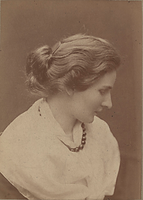 Mary Paley Marshall (October 24, 1850 – March 19, 1944) was a groundbreaking British economist and a central figure in the fight for women’s higher education in the United
Kingdom. As one of the first five female students at Newnham College, Cambridge, and the university’s first female economics lecturer, she blazed trails in an era that
systematically excluded women from academic life.
Mary Paley Marshall (October 24, 1850 – March 19, 1944) was a groundbreaking British economist and a central figure in the fight for women’s higher education in the United
Kingdom. As one of the first five female students at Newnham College, Cambridge, and the university’s first female economics lecturer, she blazed trails in an era that
systematically excluded women from academic life.
Born in Ufford, Lincolnshire, to an evangelical rector, Mary was educated at home before winning a scholarship in 1871 to study at Newnham College, Cambridge.
In 1874, she became one of the first women to sit for the Moral Sciences Tripos examination, passing with honors. However, because of Cambridge’s strict gender
restrictions at the time, she was denied a formal degree and awarded only a confidential letter of achievement.
In 1875, Newnham College appointed her as its first female lecturer in economics.
In 1877 she married her former tutor, the prominent economist Alfred Marshall. Due to rules requiring Cambridge Dons to remain unmarried, they temporarily moved to
Bristol, where she became one of University College Bristol's first female lecturers.
Together, they wrote The Economics of Industry (1879). The book was praised by economists like John Maynard Keynes, but
Alfred eventually allowed it to go out of print and sidelined Mary’s contributions in later works.
Alfred later opposed women being awarded formal Cambridge degrees, yet Mary quietly persevered, continuing to lecture at Newnham and Girton until 1916.
Following Alfred’s death in 1924, Mary became the honorary librarian of the Marshall Library of Economics at Cambridge, managing and curating the collection into her
late 80s.
For the majority of her adult life and until her death in 1944, Mary Paley Marshall lived at her home Balliol Croft (later renamed Marshall House), 6 Madingley Road,
Cambridge, CB3 0EE. Built in 1886 by Mary Paley Marshall and her husband, economist Alfred Marshall, the house served as their long-time residence. Mary continued to live
there after Alfred's death in 1924 until her own passing on March 19, 1944. The property was later acquired by Lucy Cavendish College, Cambridge, and was renamed Marshall
House in honor of the family legacy.
While Mary Paley Marshall spent her life in a heterosexual marriage, her legacy intersects with LGBTQ+ history, queer studies, and the history of gender non-conformity
in several distinct ways:
Newnham College was a primary crucible for late-Victorian female solidarity, independence, and same-sex emotional intimacy. Historians of LGBTQ+ and women's history
highlight that late 19th-century all-female university spaces fostered "romantic friendships" and intimate bonds between women that challenged traditional heterosexual
family structures. Mary belonged to the foundational inner circle of Newnham women who chose academic autonomy over conventional Victorian domestic expectations.
In 1890, Mary became an active member of the Ladies Dining Society, an exclusive Cambridge group of intellectual
women. The society offered an autonomous homosocial space where female scholars and activists dinned, debated, and built lifelong support networks outside the authority of
their academic husbands.
Mary formed a deep, reciprocal relationship with John Maynard Keynes, a towering figure in 20th-century economics and an active, openly bisexual member of the queer
Bloomsbury Group.
Keynes admired Mary enormously, considering her an intellectual heavyweight in her own right.
After her death in 1944, Keynes authored a celebrated biographical memoir in The Economic Journal, honoring her dignity, humor, and contributions to economic
history.
Mary was also closely allied with key women in Keynes's circle, including his mother, Florence Ada Keynes, and activist
Eglantyne Jebb (founder of Save the Children).
In modern queer and feminist academic research, scholars analyze figures like Mary Paley Marshall to understand how Victorian women navigated institutional misogyny and
lived outside patriarchal norms. Her ability to maintain an independent intellectual identity in an environment hostile to female agency makes her a key historical subject
in studies of gender non-conformity within British academia.
References:
Other references:
- https://en.wikipedia.org/wiki/Mary_Paley_Marshall
- https://grokipedia.com/page/mary_paley_marshall
- https://www.hetwebsite.net/het/profiles/paleymarshall.htm
Support this project
This website is a passion project researched, developed, and funded entirely by me. If you find the content valuable and would like to help support the ongoing research and hosting costs, any contribution is deeply appreciated.
Thank you for keeping this independent resource alive!
My books on Amazon: Elisa Rolle's books
BACK TO HOME PAGE
